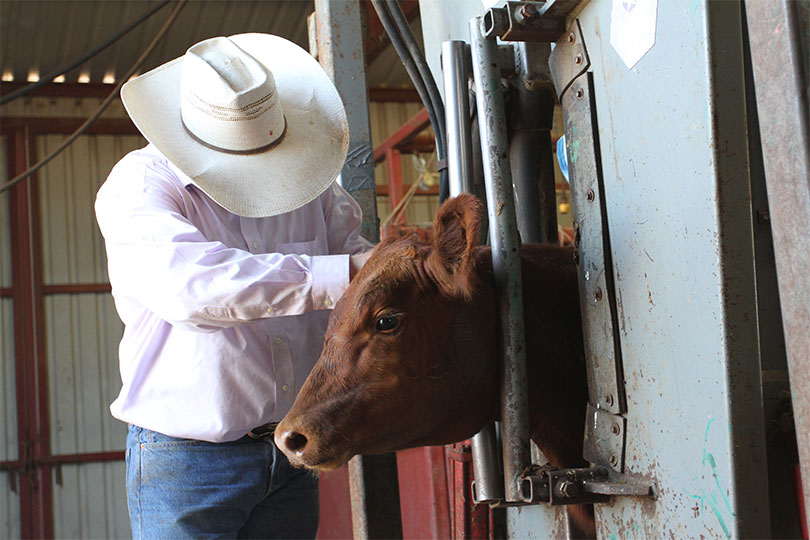
“These CRP Climate Change Mitigation Assessment Initiative projects
will survey, sample and measure the climate benefits of land enrolled in
CRP conservation practice types over time,” said Zach Ducheneaux,
Administrator of USDA’s Farm Service Agency (FSA). “This data will help
USDA better target CRP practices to achieve continued climate wins
across environmentally sensitive lands while strengthening our modeling
and conservation planning resources for all producers.” (USDA, Public
Domain)
WASHINGTON — The U.S. Department of Agriculture (USDA) is
investing $10 million in a new initiative to sample, measure, and
monitor soil carbon on Conservation Reserve Program (CRP) acres to
better quantify the climate outcomes of the program. CRP is an important
tool in the Nation’s fight to reduce the worst impacts of climate
change facing our farmers, ranchers, and foresters. This initiative will
begin implementation in fall 2021 with three partners. Today’s
announcement is part of a broader, long-term soil carbon monitoring
effort across agricultural lands that supports USDA’s commitment to
deliver climate solutions to agricultural producers and rural America
through voluntary, incentive-based solutions.
“These CRP Climate Change Mitigation Assessment Initiative projects
will survey, sample and measure the climate benefits of land enrolled in
CRP conservation practice types over time,” said Zach Ducheneaux,
Administrator of USDA’s Farm Service Agency (FSA). “This data will help
USDA better target CRP practices to achieve continued climate wins
across environmentally sensitive lands while strengthening our modeling
and conservation planning resources for all producers.”
These models include the Daily Century Model, or DayCent, which
simulates the movement of carbon and nitrogen through agricultural
systems and informs the National Greenhouse Gas Inventory. Data will also be used to strengthen the COMET-Farm and COMET-Planner tools,
which enable producers to evaluate potential carbon sequestration and
greenhouse gas emission reductions based on specific management
scenarios.
USDA partners will conduct soil carbon sampling on three categories of CRP practice types: perennial grass, trees, and wetlands.
Perennial grasses: In consultation with USDA,
Michigan State University will sample and measure soil carbon and bulk
density of CRP grasslands (including native grass plantings, rangelands,
and pollinator habitat plantings) at an estimated 600 sites across the
U.S. with a focus in the central states during this five-year project.
This information will be used to model and compare the climate benefits
of CRP. Partners include the University of Wisconsin-Madison, the
University of Arkansas at Pine Bluff, Deveron, an agriculture technology
company, and Woods End Laboratories.
“Our interdisciplinary team is excited to work with FSA on assessing,
monitoring, and modeling the climate benefits of CRP,” said Professor
Bruno Basso, Michigan State University. “Our proposed integrated system
for sampling and modeling soil organic carbon accrual and ecosystem
services in CRP lands aims to maximize climate outcomes to mitigate the
deleterious effects of climate change on our planet”.
Trees: Mississippi State University will partner
with Alabama A&M University to collect above and below ground data
at 162 sites across seven states documenting CRP-related benefits to
soil and atmospheric carbon levels. Information will help further
calibrate the DayCent model. This five-year project will focus within
the Mississippi Delta and Southeast states.
“There are hundreds of thousands of acres of trees planted under the
CRP program in Mississippi and neighboring states that make a
substantial contribution to climate change mitigation, but we don’t have
a good idea how large that contribution is,” said Austin Himes,
assistant professor at Mississippi State University. “This incredible
team of partners will use a mix of traditional forestry measurements and
state of the art technologies to get an accurate estimate of those
benefits, which in turn can help policy makers incentivize tree
planting. Additionally, we get to train students to collect all that
data, providing them hands-on experience.”
Wetlands: Ducks Unlimited and its partners will
collect data on carbon stocks in wetland soils as well as vegetation
carbon levels at 250 wetland sites across a 15-state area in the central
U.S. Data will support the DayCent and additional modeling. Partners
for this five-year project include: Migratory Bird Joint Venture,
Intertribal Research and Resource Center at United Tribes Technical
College, Clemson University, Kenyon College, Lincoln University,
Pennsylvania State University, the University of Missouri, and the
University of Texas at Austin.
“We’ve long known wetlands offer many ecosystem services that have an
outsized benefit for wildlife and people” said Dr. Ellen Herbert, DU’s
Ecosystem Services Scientist. “This study will help improve our
understanding of the potential of CRP restored wetlands to mitigate the
effects of climate change, improve water quality and provide habitat. We
believe the data gathered from this study will ultimately help
demonstrate the effectiveness and overall values of CRP. And, we greatly
appreciate USDA for selecting DU to partner in this project.”
CRP Monitoring, Assessment, and Evaluation Projects
These three Climate Change Mitigation Assessment Initiative projects
are funded through FSA’s program to work with partners to identify Monitoring, Assessment and Evaluation (MAE) projects to quantify CRP environmental benefits to water quality and quantity, wildlife, and rural economies.
Applications for projects were welcome from all organizations,
including public, private, nonprofit institutions, and educational
institutions including historically Black colleges and universities,
Tribal colleges and universities and Hispanic-serving institutions or
organizations.
For more details on the all the awarded MAE projects, visit the FSA Monitoring Assessment & Evaluation webpage.
About the Conservation Reserve Program
CRP is one of the world’s largest voluntary conservation programs,
with an established track record of preserving topsoil, sequestering
carbon, reducing nitrogen runoff and providing healthy habitat for
wildlife.
In exchange for a yearly rental payment, agricultural producers
enrolled in the program agree to remove environmentally sensitive land
from production and plant species that will improve environmental health
and quality. In general, land is enrolled in CRP for 10 to 15 years,
with the option of re-enrollment. FSA offers multiple CRP signups, including
the general signup and continuous signup, as well as Grassland CRP and
pilot programs focused on soil health and clean water. In
2021, producers and landowners enrolled more than 5.3 million acres in
CRP signups, surpassing USDA’s 4-million-acre goal.
Earlier this year, USDA announced updates to CRP including
higher payment rates, new incentives for environmental practices, and a
more targeted focus on the program’s role in climate change mitigation.
This included a new Climate-Smart Practice Incentive for CRP general
and continuous signups that aims to increase carbon sequestration and
reduce greenhouse gas emissions. Climate-Smart CRP practices include
establishment of trees and permanent grasses, development of wildlife
habitat, and wetland restoration. Download the “What’s New” fact sheet to learn more about CRP updates.
More Information
Under the Biden-Harris Administration, USDA is engaged in a
whole-of-government effort to combat the climate crisis and conserve and
protect our nation’s lands, biodiversity, and natural resources
including our soil, air, and water. Through conservation practices and
partnerships, USDA aims to enhance economic growth and create new
streams of income for farmers, ranchers and private foresters.
Successfully meeting these challenges will require USDA and our agencies
to pursue a coordinated approach alongside USDA stakeholders, including
State, local, and Tribal governments.
USDA touches the lives of all Americans each day in so many positive
ways. In the Biden-Harris Administration, USDA is transforming America’s
food system with a greater focus on more resilient local and regional
food production, fairer markets for all producers, ensuring access to
healthy and nutritious food in all communities, building new markets and
streams of income for farmers and other producers using climate smart
food and forestry practices, making historic investments in
infrastructure and clean energy capabilities in rural America, and
committing to equity across the Department by removing systemic barriers
and building a workforce more representative of America. To learn more,
visit www.usda.gov.
USDA is an equal opportunity provider, employer and lender.