The Texas Animal Health Commission (TAHC) continues to
support local, state, and federal public health officials as they
respond to the new coronavirus disease 2019 (COVID‑19) that is
causing the outbreak of respiratory illness in people worldwide.
As such, the TAHC would like to provide you credible
information and resources when it comes to livestock and pets. This
is a rapidly evolving situation and information will be updated as it
becomes available. Check our website, www.tahc.texas.gov, often for the latest details on
COVID-19 as it relates to animal health.
Frequently
Asked Questions:
What are
coronaviruses?
Coronaviruses
are a large family of viruses. Some strains affect animals, while
others affect people. The majority of coronaviruses stick to their
own species. COVID-19 has not been proven to circulate between people
and animals.
Can animals
become ill with COVID-19?
To date, the
Centers for Disease Control (CDC) has not received any reports of
pets or livestock becoming sick with COVID-19 in the United
States. The first case of an animal testing positive for the
virus in the United States was a tiger, that had a respiratory
illness, at a zoo in New York City.
The CDC is
aware of a very small number of pets outside the United States to be
infected with the virus that causes COVID-19, SARS-CoV-2. Infectious
disease experts and multiple international and domestic human and
animal health organizations agree there is no evidence at this point
to indicate that animals spread COVID-19 to people. Further studies
are needed to understand if and how different animals could be
affected by COVID-19.
At this time
there is no evidence to suggest any animals, including pets or
livestock, can spread COVID-19 infection to people.
Should any
animal showing signs of respiratory illness be tested?
If your pet is
showing signs of a respiratory infection, consult with your
veterinarian so they can assess the animal for common respiratory
illnesses. The TAHC, Department of State Health Services (DSHS), USDA
and CDC do not recommend routine testing of animals for this virus.
Because the situation is ever-evolving, public and animal health
officials may decide, out of an abundance of caution, to allow
testing of certain animals after consulting with the attending
veterinarian.
Should I avoid contact with pets or
other animals if I have COVID-19?
Although there have not been reports
of pets becoming sick with COVID-19 in the U.S. it is still
recommended that people sick with COVID-19 limit contact with animals
until more information is known about the virus. When possible, have
another member of your household care for your animals while you are
sick. If you are sick with COVID-19, avoid contact with your pet,
including petting, snuggling, being kissed or licked, and sharing
food. If you must care for your pet or be around animals while you
are sick, wash your hands before and after you interact with them.
What
services are considered Essential Critical Infrastructure for Food
and Agriculture?
On March 19,
2020 the Department of Homeland Security (DHS) identified the
specific industries that comprise Critical Infrastructure Industries including
food and agriculture. The list of services included in the critical
food and agriculture infrastructure can be viewedhere.
Are
livestock markets open?
Livestock
markets are open and continue to operate across the U.S. and Texas.
Please contact your local market if you have questions. Please note,
livestock markets are working with their state and local
public health officials to implement appropriate measures
to reduce the spread of COVID-19.
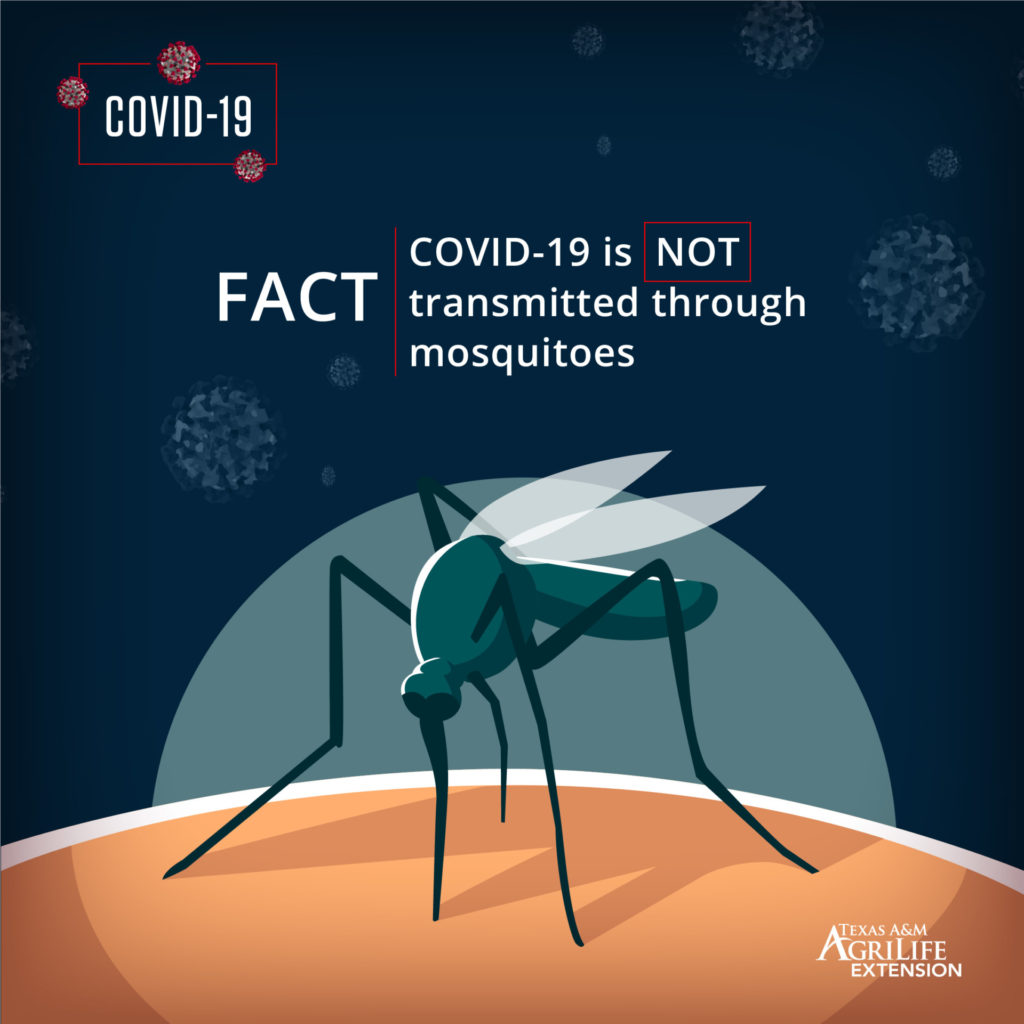
At this time, there is no scientific evidence that COVID-19 is
transmitted by mosquitoes and ticks, explained Texas A&M AgriLife experts.
“Ticks, like mosquitoes, are blood-feeding external parasites,”
said Pete Teel, Ph.D., Texas A&M University interim head for the Department of Entomology in the College of Agriculture and Life Sciences.
“The viruses they are known to transmit to humans must survive and grow, or
replicate, inside the tick as well as survive through tick developmental
stages.”
Mosquitoes, ticks and other blood-feeding arthropods are vectors of other viruses and pathogens.
“People still need to exercise caution and good judgment in avoiding
bites,” said Zach Adelman, professor in the Department of Entomology.
“But there is no evidence that a coronavirus can survive being digested
by a mosquito, let alone transmitted to another person.”
As a result of social distancing, people are also spending more
time outside. This is understandable as many outdoor activities like running,
biking, etc., are very compatible with social distancing, explained Kevin
Myles, professor in the Department of
Entomology.
“One unintended consequence of this trend is that people may be
increasingly exposed to mosquitoes and other disease vectors as the weather
warms. As a result, everyone should be reminded to wear appropriate clothing
and insect repellant when spending time outdoors, as vector-borne diseases
continue to pose a threat to public health, in addition to flu and COVID-19,”
Myles said.
The virus is thought to spread mainly from
person-to-person including people who are in close contact with one another—within
about six feet—and through respiratory droplets produced when an infected
person coughs or sneezes. These droplets can land in the mouths or noses of
people who are nearby or possibly be inhaled into the lungs.
The World Health Organization has also reported there is no information nor evidence,
at this time, to suggest that that novel coronavirus could be transmitted by
mosquitoes.
The American Mosquito Control Association is monitoring the situation.
For more information regarding the
Coronavirus, visit Texas A&M AgriLife’s Disaster Education Network.
To help prevent the spread and protect
yourself, wash hands under soap and water for at least 20 seconds, use a hand
sanitizer containing at least 60% alcohol, avoid close contact and practice social
distancing.